
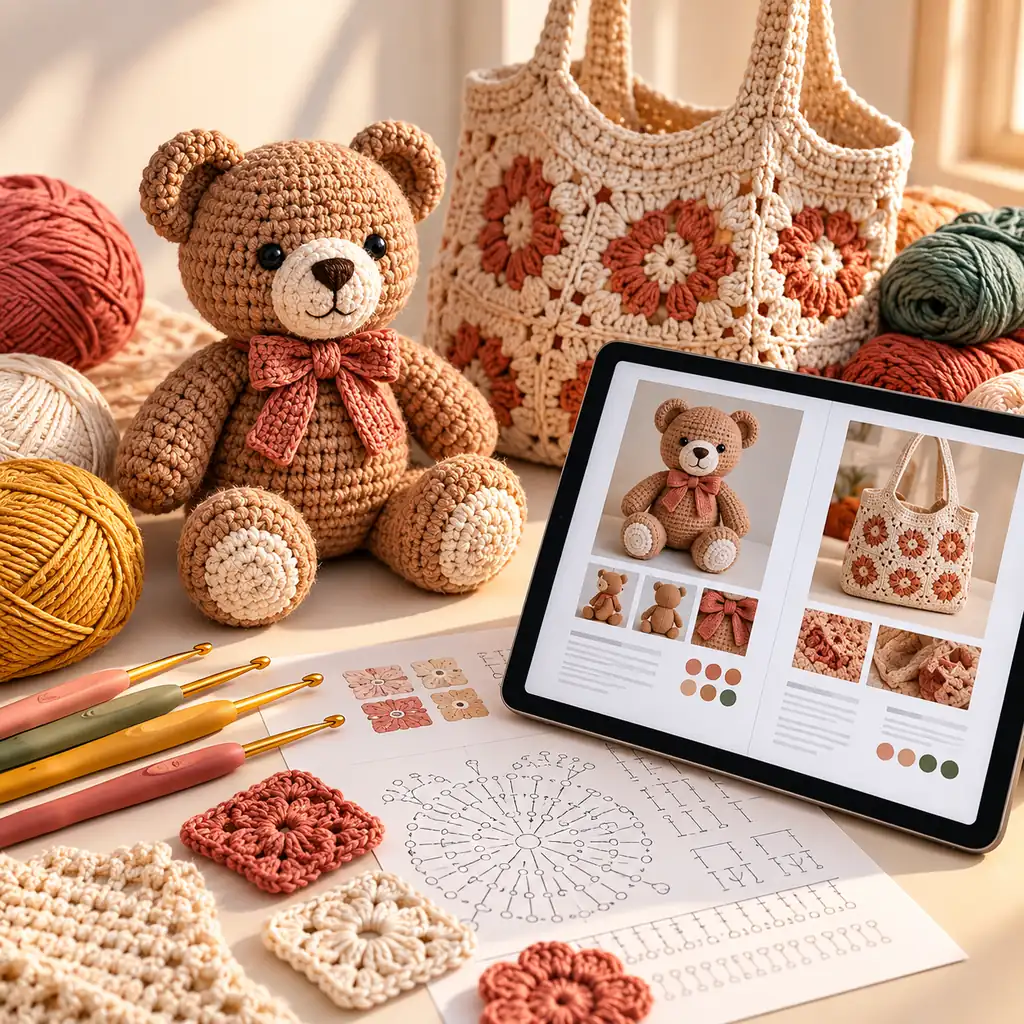

Crochet PDF patterns are a digital product with a particularly clear promise: a buyer pays for instructions that help them make a specific finished item. Unlike a finished physical crochet product, a PDF pattern can be delivered repeatedly without packaging and postage. But repeat delivery does not mean repeat sales are automatic. A successful pattern needs accurate instructions, a desirable finished result, and proof that another crocheter can follow it.
Choose a pattern people can evaluate quickly
Start with a narrowly defined project: a beginner-friendly coaster set, a small plush character, a market bag, or a textured baby blanket. Match the difficulty level to the finished item. Avoid designing a bundle before validating that one pattern is genuinely usable.
What a high-quality crochet PDF should contain
- A clear cover showing the actual finished project.
- Finished dimensions, yarn weight, hook size, gauge and estimated yarn consumption.
- Skill level, US or UK terminology and an abbreviations glossary.
- Numbered steps with stitch counts at the end of each round or row.
- Original photographs showing difficult joins, shaping and assembly.
- Care instructions, construction notes and correction contact details.
- Printer-friendly pages as well as a screen-readable version where practical.
Test the instructions before selling
Ask two or three testers with different experience levels to complete the project using only the PDF. Give them a structured feedback form: where did they pause, which stitch count failed, and what photo was missing? Correct the document, update the version number, and repeat a targeted test. Check every step against the sample piece; attractive mockups are not evidence that a pattern works.
Format for phones and printers
Build the pattern in a document editor with heading styles and a consistent measurement system. Export to PDF; check the file on both mobile and desktop. Keep photo captions next to the relevant steps. Use legible contrast and don’t rely on color alone to explain shaping.
Pricing your first release
Compare genuinely similar original patterns by complexity, size, tester coverage and bundle depth. Set a price that compensates for design, testing, support and revisions. A short coaster pattern and a detailed garment with multiple sizes are not equivalent products. Test a single-pattern listing first, then consider a themed bundle after you know which projects interest customers.
What to show in the listing
Make the title specific: finished item, technique, skill level and PDF format. Include pictures of the actual finished project, an excerpt from the instructions, the materials list and a prominent digital download; no physical item shipped disclosure. Explain whether purchasers may sell objects made from the pattern and whether the pattern document itself can be resold or redistributed.
Launch and learn
- Publish one test-validated pattern.
- Use clear preview images and a descriptive filename.
- Track listing impressions, clicks, purchases, refunds and support questions.
- Improve the cover or copy when clicks are weak; improve instruction clarity when support requests cluster.
- Use customer feedback to choose the next design.
For a marketplace-based launch, prepare your PDF, original product images and license statement before creating a listing on Digjy. Check the current seller rules and fees before publishing.
FAQ
Can beginners sell crochet patterns?
Yes, provided the design is original, the instructions work, and the difficulty is described accurately. Designing and testing a simple project is a better first step than offering a large untested collection.
Should I include editable files?
Usually the PDF is enough for buyers. Keep your editable source file privately so you can revise it without offering redistribution rights to purchasers.
Can I use someone else’s pattern as a starting point?
Respect copyright and licensing; do not copy or lightly rewrite another designer’s instructions or photos. Create and document your own design.
Worked example: test a simple coaster pattern before launch
Suppose you are preparing a four-coaster PDF set. This is a hypothetical production checklist, not a claim that the pattern has been tested. Write down the yarn category, hook diameter in millimeters, gauge, finished coaster diameter and yarn amount. Photograph one sample from above and from the side. Have a tester follow the PDF without your help, then compare their stitch counts and finished dimensions against yours.
Use consistent yarn-weight terminology. The Craft Yarn Council’s standard yarn-weight system provides common category names and gauge guidance. The council also publishes crochet abbreviation standards. These are reference conventions; a gauge swatch and the instructions for your specific design still matter.
Before-and-after tester log
| Issue observed | Revision to make | Retest |
|---|---|---|
| Tester gets the wrong stitch count in round 4 | Rewrite that round with an explicit count | Have a second tester work round 4 from the revised PDF |
| Joining photo is unclear | Add a close-up photo with the joining point marked | Ask a tester to join without verbal coaching |
| Finished coaster is larger than described | Confirm gauge, hook size and dimensions | Recheck against a new sample |
For other starter products, see 15 digital product ideas for beginners. For a different kind of printable PDF, compare the quality checklist in educational activity printables.
Research note: Industry-standard craft terminology is supported by the Craft Yarn Council. No sales, conversion or search-volume data specific to this proposed coaster pattern has been measured.