
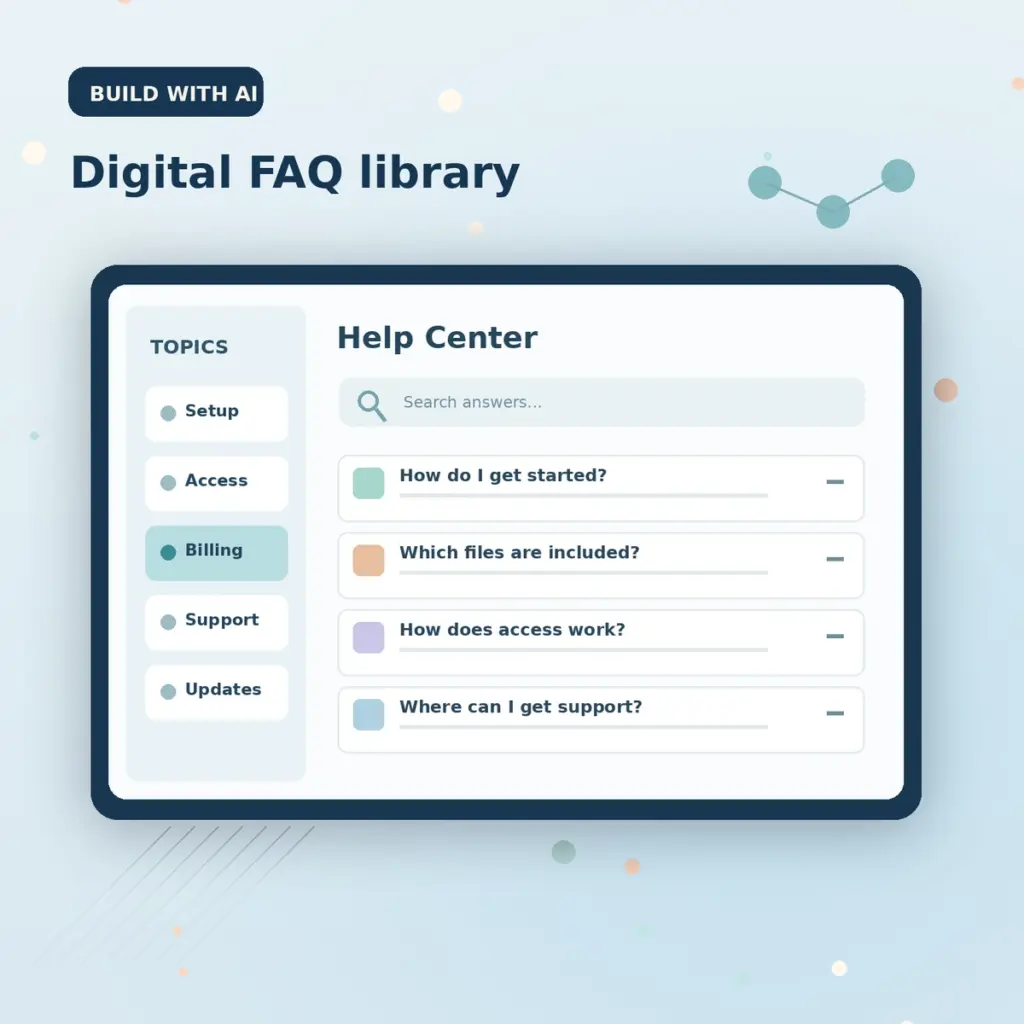

An AI FAQ knowledge base template is a useful digital product when it helps an organization answer recurring customer questions with accurate, maintainable information. AI can organize source notes into topic clusters and draft clearer language. It cannot know a buyer’s actual shipping policy, refund terms, service boundaries or account permissions without verified source material. A good template leaves room for those facts rather than inventing plausible-sounding answers.
Choose a specific buyer and support workflow
Consider a fictional independent digital-template seller whose common questions involve file access, compatible software, license rights, updating an order and contacting support. The deliverable could be a reusable web-based knowledge-base layout, a Notion document, an editable spreadsheet, or a set of structured Markdown/HTML pages. Decide the supported format before creating previews or claiming search functionality.
Make a source-of-truth inventory first
List each authoritative document or policy that a buyer will need to provide. Separate facts that are stable (file types) from decisions that change (fees, support hours, refund windows). A source table helps prevent AI from quietly inventing business terms.
| FAQ topic | Authoritative source | Update trigger |
|---|---|---|
| Download access | Actual checkout and delivery settings | Storage or checkout change |
| License rights | Current product license terms | New product or policy revision |
| Compatible software | Tested file requirements | File-version change |
| Refund process | Approved published business policy | Policy or legal review |
| Contact support | Verified contact method | Staffing or address change |
Prompt AI to draft, with uncertainty preserved
Using only the verified source notes supplied below, organize customer support information into five categories and draft plain-language answers. Each answer must cite its specific source note. If a fact is missing, write NEEDS OWNER APPROVAL rather than guessing. Do not invent prices, deadlines, guaranteed service levels, refunds or technical compatibility. Return a list of questions that require manual validation before publication.
One useful review practice is to highlight every statement that has no corresponding source. Replace it or remove it. Do not publish a source link if the page is inaccessible to the buyer or if the cited source no longer supports the answer.
Design the content structure for findability
A practical knowledge base includes a short topic landing page, search or index navigation when actually implemented, categorized question pages, last-reviewed dates, related articles, and a contact escalation path. The user should be able to find “How do I open my downloaded ZIP?” without guessing which department owns it. Keep question titles in the language customers use.
For accessible HTML, use real heading elements in a logical order, descriptive links and keyboard-operable controls. A screenshot of an accordion does not prove it opens or works with assistive technology. If search is not implemented, label the deliverable as a navigable FAQ template rather than a functioning search engine.
Worked example: answer a download question
Question: “Where do I find my purchased file?”
Bad AI draft: “Every order instantly appears in your account and we always email a link.” That is an unverified guarantee.
Better template: “After completing payment, look for the download access information shown during checkout or in the account area, if enabled by this store. If you cannot locate it, contact [verified support method] with your order reference.” The owner must replace bracketed placeholders and test their own checkout setup before publication.
Test both content and technical behavior
- Provide the template with fictional sample policies and a clear replace-before-publishing notice.
- Verify each link opens the intended topic and works without the creator’s logged-in account.
- Test keyboard navigation and headings on desktop and mobile.
- Search for several customer phrases if real search is an advertised feature.
- Change a policy in the source and confirm the owner can locate affected answers.
- Review the package for private account details, API keys and customer records.
Package for the buyer’s existing tools
Give the buyer an editable source file, a structured topic map, a short configuration guide and a content review checklist. Provide the final output in the exact formats you promise. If using Notion, test duplication; if using HTML, test the target host; if using a document, verify working bookmarks and links. Notion’s official template selling documentation emphasizes ensuring linked content is accessible to a new duplicator.
For a broader product test method, read quality-test editable templates. For product delivery concerns, use our ZIP and download access guide.
Search visibility and ongoing maintenance
Google’s guidance on generative AI website content warns that publishing large amounts of low-value AI material for ranking manipulation can violate spam policies. For FAQs, accurate sourced answers, distinct customer questions and accessible navigation matter more than bulk page count. Measure searches within the help center, support tickets and customer confusion only if the buyer has legitimate analytics and appropriate privacy practices.
Frequently asked questions
Is a prompt list the same as a knowledge base?
No. Prompts suggest content; a knowledge base is an organized, verified and maintainable information system.
Can I advertise AI answers as automatically accurate?
No. A responsible template should require source verification and a human approval step.
Does a FAQ template include working search?
Only if a search feature is actually implemented and tested in the buyer’s environment. Otherwise describe navigation and indexing accurately.
Production note: Sample questions and sources are illustrative and do not represent any company’s verified refund, warranty, security or access policy.